This Women’s Health Week, it’s important we talk about one of the biggest recent shifts in women’s health research and advocacy- the renaming of PCOS (Polycystic Ovarian Syndrome) to PMOS (Polyendocrine Metabolic Ovarian Syndrome).
And honestly, for the first time in a long while I feel hopeful seeing this condition finally recognised as something more than just our ovaries!

When I was diagnosed at the age of 21 with PCOS (the older term now), I understood very little about the condition. And to be fair, much of the medical conversation around it was still heavily centred around the ovaries. I did have ovarian cysts at certain points, but what confused me was that the cysts would often come and go. Sometimes scans showed cysts and sometimes they did not. And when doctors saw scans without cysts, the response was often that my condition was now ‘fine’ or somehow resolved.
My periods were irregular and only appeared 5-6 times a year. But when they did arrive, they were extremely heavy, painful and exhausting. At the same time, I was also dealing with other symptoms that silently shaped my daily life- fatigue, weight gain (that almost felt impossible to lose), hair loss, facial hair, anxiety, sleep disruption and emotional confusion of not fully understanding what was happening to my body. Like many women living with the condition, I was often told that my symptoms were simply related to my weight. I was even told at one point during my late 20s that marriage and having a child could ‘solve’ the problem.
Looking back now, I realise how narrowly the condition was framed, both medically and socially!
At the time, I viewed it mainly as a reproductive or menstrual condition. Years later, both as someone living with the condition and now researching menstrual and mental health, I have realised how incomplete that understanding really was.
Recently, a major Lancet paper outlined an international consensus to rename PCOS to PMOS-Polyendocrine Metabolic Ovarian Syndrome. And honestly, the more I read about the rationale behind this change, the more it makes sense.
The paper argues that the term PCOS has long been inaccurate and misleading because it places disproportionate emphasis on ovarian cysts, despite the condition extending far beyond the ovaries themselves. In fact, many people diagnosed with PCOS do not even have pathological ovarian cysts. Instead, disrupted follicular development is common, meaning that immature follicles fail to develop and ovulate normally 1.
What research now increasingly shows is that this is fundamentally a multisystem condition underpinned by endocrine and metabolic disturbances. The impacts can be metabolic (including obesity, insulin resistance, type 2 diabetes, cardiovascular disease, hypertension, sleep apnoea) , reproductive (including menstrual irregularity, infertility, pregnancy complications, endometrial cancer), psychological (including depression, anxiety, poor quality of life, eating disorders), and dermatological (including acne, alopecia, hirsutism) 1–3.
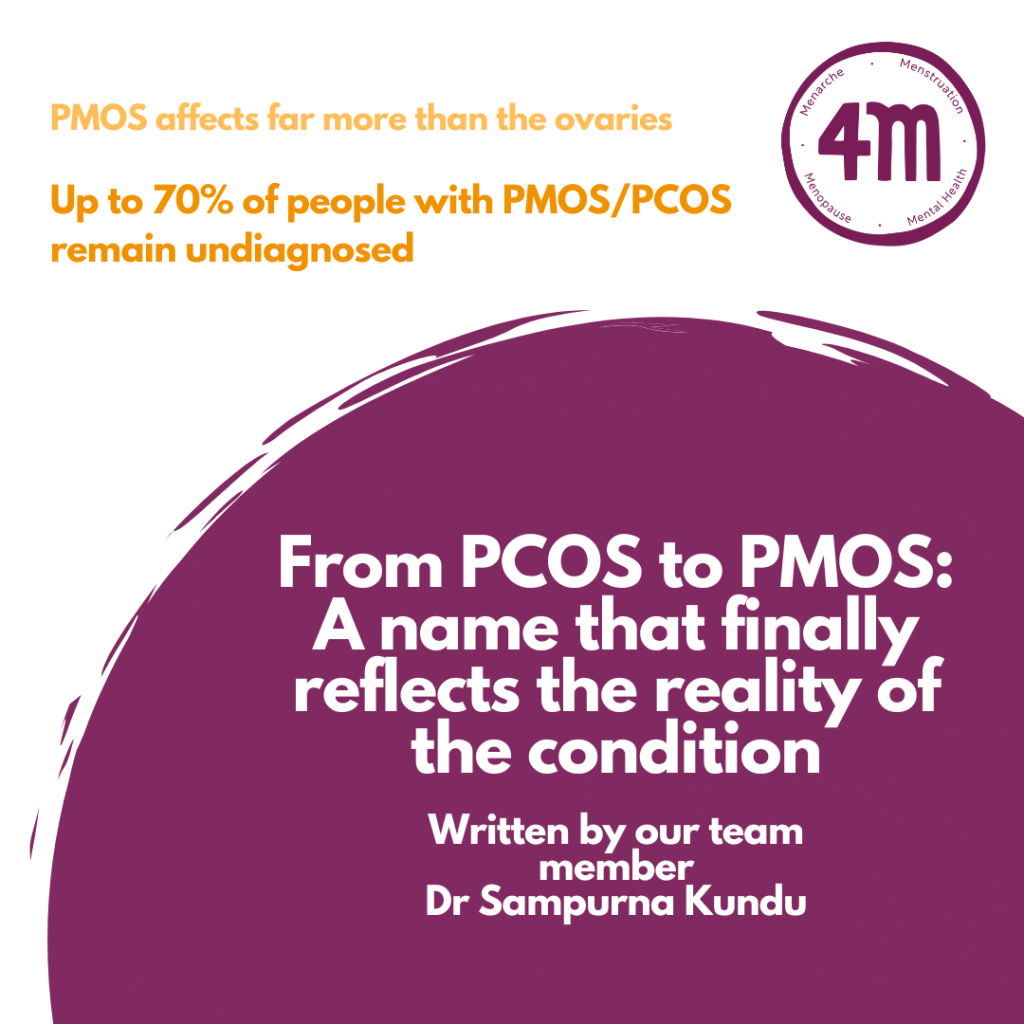
Another striking point raised in the paper was that up to 70% of affected individuals may remain undiagnosed 1. The authors suggest that the misleading terminology itself has partly contributed to delayed diagnosis, fragmented care, stigma, and poor awareness surrounding the condition.
What I also appreciated was that the paper did not present this renaming as an overnight rebrand. Instead, it discussed a carefully planned international implementation strategy involving transition periods, education, updates to clinical guidelines, disease classification systems, advocacy efforts, and broader public communication.
In many ways, the renaming to PMOS finally acknowledges what patients have been trying to explain for years, that this condition affects far more than fertility or ovaries alone.
And for me, that recognition matters deeply because the condition never existed only in my ovaries. It existed in my exhaustion, my mental health, my body image, my sleep, my confidence and the constant effort of trying to function normally while feeling physically and mentally overwhelmed. Over time, I also realised that it wasn’t just the periods themselves affecting me, but the long PMS symptoms leading up to them. Sometimes it feels like a significant part of the month is spent either anticipating, managing, or recovering from symptoms.
Another difficult aspect has been the constant struggle with weight and fitness. Despite trying to maintain a healthy lifestyle, staying within a ‘normal’ BMI often felt really difficult, and over time that deeply affected my body image and self-confidence. Like many people living with PMOS, I often felt blamed for symptoms that were far more complex than simply lifestyle choices.
Heavy menstrual bleeding has also remained one of the hardest symptoms to manage. People often speak about heavy and painful periods casually, but rarely talk about the fear of leaking in public, the anxiety around travelling while menstruating, or the exhaustion that comes from losing large amounts of blood over several days. Even using superflow pads and double protection, leaking has remained a recurring reality for me. What often goes unspoken is how menstrual symptoms quietly shape professional and social life too.
Menstrual suffering is still frequently normalised, minimised, or treated as something women should simply ‘push through’. And perhaps that is part of why so many people living with PMOS spend years feeling unheard, misunderstood, or dismissed.
What fascinated me even more was learning the history behind the diagnosis itself. Long before the term PCOS existed, the condition was originally referred to as Stein-Leventhal Syndrome, named after Irving Stein and Michael Leventhal, who had identified the condition in 1935. They formally described a few clusters of symptoms such as amenorrhea, hirsutism, infertility and enlarged ovaries. But interestingly, historical records suggest that observations of polycystic ovaries and menstrual disturbances actually date back much earlier, even to the mid-1800s. Over time, scientific understanding of the condition evolved through what researchers describe as endocrine, metabolic, and eventually molecular ‘eras’ of research 4.
And perhaps that evolution itself tells an important story. For decades women living with the condition were experiencing symptoms that extended far beyond what the name itself captured. The science evolved, but the terminology stayed behind.
The disconnect matters. Because names shape understanding.
They shape diagnosis, research priorities, public awareness, and even how seriously patients are taken when describing their symptoms.
Now in my 30s, I manage my symptoms far better than I did in my early twenties. My periods are more regular, and I’ve learned how lifestyle, routine, and self-awareness influence my health. But PMOS still remains part of my daily life.
Perhaps that is why this name change feels so important to me. Not because changing the name suddenly changes our symptoms overnight, but because names shape how conditions are understood and taken seriously. For years, many of us were living with symptoms that affected far more than just our ovaries, while the terminology never fully reflected that reality. In many ways, PMOS feels like science is finally starting to catch up with lived experience. And I genuinely hope this shift changes more than just language. I hope it leads to earlier diagnosis, better research, more holistic care, and fewer people feeling dismissed or misunderstood the way so many of us once did.
As someone who now research menstruation and mental health while also living with PMOS, I’ve realised how important it is for scientific research and lived experience to exist together. Statistics tell us how common these conditions are, but lived experiences tell us what they actually feel like to live through every day.
And perhaps that is why this name change matters, because for many of us, it finally reflects the reality we have been living with all along!
Written by Dr Sampurna Kundu, Postdoctoral Research Fellow in Epidemiology, University of Exeter
Email- s.kundu@exeter.ac.uk
References
1. Teede, H. J., Khomami, M. B., Morman, R., Laven, J. S. E., Joham, A. E., Costello, M. F., Patil, M., Rees, D. A., Berry, L., Cree, M. G., Zhao, H., Norman, R. J., Dokras, A., & Piltonen, T. (2026). Polyendocrine metabolic ovarian syndrome, the new name for polycystic ovary syndrome: A multistep global consensus process. The Lancet, 0(0). https://doi.org/10.1016/S0140-6736(26)00717-8
2. Teede, H. J., Misso, M. L., Costello, M. F., Dokras, A., Laven, J., Moran, L., Piltonen, T., Norman, R. J., & International PCOS Network. (2018). Recommendations from the international evidence-based guideline for the assessment and management of polycystic ovary syndrome. Human Reproduction, 33(9), 1602–1618. https://doi.org/10.1093/humrep/dey256
3. Mousa, A., Tay, C. T., & Teede, H. (2023). Technical Report for the 2023 International Evidence-based Guideline for the Assessment and Management of Polycystic Ovary Syndrome: 2023 Update. https://doi.org/10.26180/23625288.v1
4. Adashi, E. Y., Cibula, D., Peterson, M., & Azziz, R. (2022). The polycystic ovary syndrome: The first 150 years of study. F&S Reports, 4(1), 2–18. https://doi.org/10.1016/j.xfre.2022.12.002

