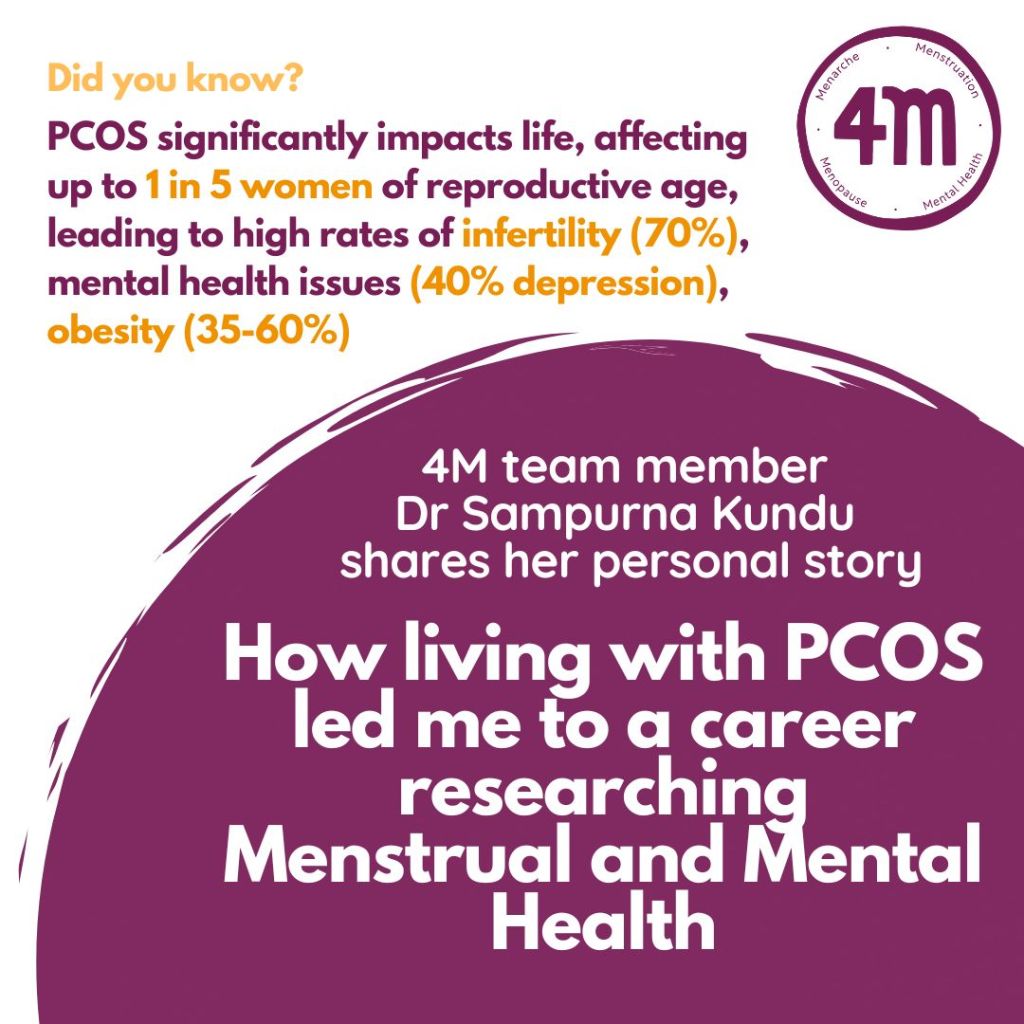
Hi, I’m Dr Sampurna Kundu, currently a Postdoctoral Research Fellow in Epidemiology at the University of Exeter, working in the area’s menstruation, menopausal and mental health.
As much as I love what I do, I have to say, it has a lot to do with my personal experiences!
The diagnosis that quietly changed my life
I was diagnosed with polycystic ovary syndrome (PCOS) in 2017, during the final year of my undergraduate degree. I knew something was happening inside my body that I couldn’t fully understand. At the time, I had no plans to become a researcher. I didn’t even really know what a PhD would look like.
But that diagnosis planted a seed.
It wasn’t until my master’s degree that something shifted. During one module, I was introduced to research, and something clicked instantly. The research methodology module introduced me on how one begins research, and how to develop research questions. Suddenly, research wasn’t an academic activity; it became a way for me to explore the questions I had been carrying within me.
When the time came to choose my MSc dissertation topic, I naturally gravitated toward my lived experiences- my menstrual cycle, PCOS, and my long-standing worries about future fertility. That curiosity led me to research infertility, then later early menopause during my PhD. Though I didn’t know at that point if these were even related or not, but questioning that came from my condition became the foundation of my research journey.
What began as a personal curiosity eventually grew into a scientific journey exploring menstrual health more broadly.
PCOS is more than a medical condition, it shapes how you see yourself
Living with PCOS is complex, and it’s far more than a collection of symptoms on a medical leaflet. It influences your identity, your confidence, your relationship with your body, and sometimes, how you believe others perceive you.
Over the years, I’ve experienced:
- Weight gain
- Facial hair and hair loss
- Heavy, painful periods
- Fatigue and sleep issues
- Neck and underarm darkening
- Hormonal imbalances
- Anxiety and mood fluctuations
The symptoms have evolved over time, but the impact on daily life remained constant.
Ironically, and perhaps beautifully, I now work on my postdoctoral project ‘MenstruLife’ led by Prof Gemma Sharp, founder of the 4M Consortium. We examine how heavy menstrual bleeding and menstrual pain intersect with depressive symptoms.
In many ways, it feels like life has come full circle!
Resetting my health and Reframing my understanding of Wellness
Moving to the UK from India, and living alone gave me space to reset. I slowly learned to take control of my health rather than letting PCOS symptoms take over my life. I began:
- Eating cleaner, balanced meals
- Exercising regularly
- Prioritising good sleep
- Making mental health non-negotiable
- Listening to my body instead of fighting it
And somewhere along the way, I realised something important: Being healthy doesn’t mean being lean.
It means feeling strong, grounded, supported, and at peace in your own skin!
Why I do what I do
My lived experience with PCOS isn’t just a part of my personal life, it actively shapes the researcher I am today. It compels me to ask uncomfortable questions, to study what is overlooked, and to amplify the voices of menstrual health struggles that have long been dismissed. I research menstrual and mental health because I understand what it feels like to look for answers and find only partial explanations or none at all.
Working in menstrual and mental health has also made it impossible to ignore the persistent stigma and silence that surround menstruation- I realize this especially growing up in a South Asian household. Across cultures, menstruation is still treated as something shameful or private, despite being a fundamental biological process. These taboos shape how symptoms are reported, how care is sought, and ultimately, how research priorities are set. Challenging these norms is both a personal commitment and an academic responsibility. Research must reflect the lived realities of those it aims to serve, especially those whose experiences have historically been marginalised.
Today, many women and people who menstruate are entering research because of their own lived experiences. They are transforming personal challenges into scientific inquiry, and in doing so, reshaping the future of menstrual health research.
Together, by sharing our stories, our questions, and our knowledge, we can build a stronger, more inclusive understanding of menstrual health, one that reflects the realities of those who live it every day.
Written by Dr Sampurna Kundu, Postdoctoral Research Fellow in Epidemiology, University of Exeter
Email- s.kundu@exeter.ac.uk
 4m
4m 