Hi, I’m Dr Sampurna Kundu, and I recently started a post-doc working with Dr Gemma Sharp in the MenstruLife project. As part of my role, I’m helping to run 4M with various activities. I’ve written this blog sharing my observations based on the work I did during my PhD regarding early/premature menopause.
Menopause is the natural biological transition marking the end of a woman’s reproductive years, typically occurring between the ages of 45 and 55 [1]. However, a growing number of women across the globe are experiencing early or premature menopause, thus raising significant concerns about women’s health and well-being.
Understanding the Numbers
Globally around 5% women are reaching menopause naturally before the age of 45, according to NHS [2]. According to a study in Lancet [3], approximately 12% women experience early menopause globally, between the ages of 40 and 44, and around 2- 4% experience premature menopause, which is, before the age of 40. However, these figures are not uniform and vary by population and region. For instance, in the United Kingdom, studies report that 6.5% to 10.2% [4] of women reach menopause before age 45; while in India, premature menopause varies between 2-8% and early menopause between 12-16% [5][6]. This shows a significant proportion of women attaining menopause early and this calls for greater attention from both healthcare providers and policymakers.
Why Is Early Onset of Menopause a Concern?
Menopause is defined as the permanent cessation of menstruation, diagnosed after 12 consecutive months of amenorrhea (absence of menstrual periods). It reflects the natural depletion of ovarian follicles, leading to a sharp decline in the reproductive hormones, which are, estrogen and progesterone [7]. As a result, the menopausal transition is often accompanied by a range of physical and psychological symptoms, including hot flashes, insomnia, anxiety, forgetfulness, joint pains and much more. However, the concern extends beyond these short-term effects. Menopause also brings long-term health risks such as cardiovascular diseases, osteoporosis, type 2 diabetes, cognitive decline, and an overall reduction in quality of life [6][8].
The concern is women who undergo menopause early are exposed to these risks for a longer duration, potentially leading to earlier onset of morbidity, an increased risk of premature mortality and compromised quality of life. Moreover, premature or early menopause has profound social and emotional implications, particularly due to infertility, which may carry stigma in many cultures and can deeply affect a woman’s sense of identity and self-worth [9][10].
What Causes Early or Premature Menopause?
Menopause marks the end of the reproductive life span of a woman, but however reaching this point differs in age for many. Even though there are medical reasons like cancer treatments, hysterectomy etc that leads to menopause, but the concern arises when it occurs early naturally. This could be attributed to factors from early life that build onto the time of reaching menopause. The age at which a woman reaches menopause is influenced by a complex interplay of genetic, environmental, lifestyle, and socioeconomic factors, many of which begin early in life [4].
Some key factors associated with early or premature menopause include:
- Smoking: One of the most consistently identified risk factors. Nicotine accelerates ovarian aging and disrupts hormonal balance.
- Lower socioeconomic status (SES): Often linked with limited access to healthcare, poor nutrition, chronic stress, and exposure to environmental toxins.
- Nutritional factors: Poor nutrition during early childhood can impair reproductive development and function.
- Reproductive history: Early menarche, lack of breastfeeding, early childbirth, or use of hormonal contraceptives may influence menopausal timing.
A study based on British population [4] highlighted that certain life-course factors increased the likelihood of early menopause:
- Being breastfed for less than a month or not at all
- Experiencing gynaecological issues in the early 30s
- Not being employed in late 30s or early 40s
Similarly, my research based in India [6] points to a range of social and reproductive stressors that contribute to earlier menopause:
- Early onset of menstruation
- Marital disruptions such as divorce, separation, or widowhood
- Use of hormonal contraceptives
- Early motherhood
Based on my research work, observing the possible determinants and health consequences I had conceptualized the following framework, based on the theoretical premises of biopsychosocial model [11], social determinants of health theory [12] and integrative quality of life theory [13].
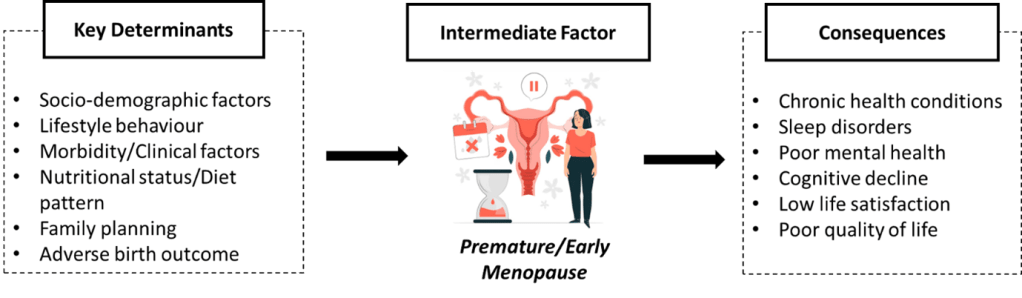
While these associations are robust, it’s important to note that causality has not been definitively established. Nonetheless, they provide important insights into which groups of women may be at greater risk and could benefit from targeted interventions.
What needs to be done?
The rising prevalence of early and premature menopause is a pressing but underrecognized global health issue. The National Institute for Health and Care Excellence in the UK has released new guidelines [14] that recommended talking therapy alongside hormone replacement therapy (HRT) in the management of menopausal symptoms. Furthermore, almost 80% of women say [15] they don’t receive enough assistance at work during menopause because they believe it’s a taboo subject. Women quitting the workforce and absenteeism are both influenced by this lack of support.
As early onset brings with it a cascade of health risks and psychosocial challenges, there is a need for, increased awareness and education, early screening with support services, and menopause inclusive policies at workplace. Conducting more research in various geographic contexts can help in understanding and addressing the root causes of early or premature menopause globally, aiming to significantly improve women’s health outcomes and quality of life across the lifespan.
Written by Dr Sampurna Kundu, Postdoctoral Research Fellow in Epidemiology, University of Exeter
Email- s.kundu@exeter.ac.uk
 4m
4m 